Knight2 43.stt.5
The cobalt isotope 6027Co decays to the nickel isotope 6028Ni.
The decay process is
A. alpha decay
B. beta-minus decay
C. beta-plus decay
D. electron capture
E. gamma decay
Answer
gc6 30.12
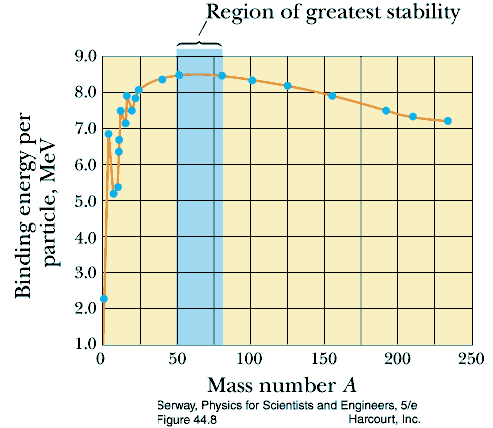
Use Appendix F to calculate the binding energy per nucleon for nitrogen-14.
A. 7.48 MeV
B. 0.112 MeV
C. 15.0 MeV
D. 105 MeV
Answer
Walker5e 32.86a
During a typical 2.5-h airplane flight, passengers are exposed to 65 µJ/h of radiation above the background
radiation they receive on the ground, mostly from cosmic ray protons that are otherwise absorbed by the
atmosphere before they reach the surface. What dose in rad is received by a 75-kg person during the flight?
A. 65 rad
B. 0.462 rad
C. 1.22 mrad
D. 217 µrad
Answer
Walker5e 32.86b
Considering the previous scenario of a 2.5-h airplane flight, what is the person's equivalent dose in rem?
A. 217 µrem
B. 46.0 rem
C. 2.17 mrem
D. 0.868 rem
Answer
Walker5e 32.86c mod
Considering the previous scenario of a 2.5-h airplane flight, and the fact that a typical chest X-ray
delivers a dose of about 2.0 mrem, how many chest X-rays are equivalent to a 8.0-h Chicago to London flight?
A. 3.5 chest X-rays
B. 1.1 chest X-rays
C. 0.34 chest X-rays
D. 0.022 chest X-rays
Answer
Walker5e 32.85
A typical chest X-ray uses X-rays with an RBE of 0.85. If the radiation dosage is 2.5 mrem, find the energy
absorbed by a 78-kg patient, assuming one-quarter of the patient's body is exposed to the X-rays.
A. 29.4 µJ
B. 0.574 mJ
C. 2.13 mJ
D. 1.66 J
Answer
B. beta-minus decay
The proton number Z has increased by one, but the atomic number
remains at 60, indicating the nucleus has undergone beta-minus decay. A neutron has changed to a
proton and ejected an electron (the beta-minus particle).
A. 7.48 MeV

D. 217 µrad

C. 2.17 mrem

A. 3.5 chest X-rays

The web site spaceweather.com includes a
predictive model of aviation radiation called E-RAD that monitors thousands of flights criss-crossing the 10 busiest routes in the
continental USA. They produce a chart that indicates changes over time of the cosmic radiation to which airplane
passengers are exposed.
B. 0.574 mJ