Summary
- Young's interference
- Thin film interference
- Diffraction


- Diffraction & resolution

- Lecture learning outcomes
A student who masters the topics in this lecture will be able to:
- describe the difference between the diffraction patterns caused by a single slit and by a circular aperture
- use algebra to find the aperture diameter D, angle to the first dark fringe θdark, or wavelength λ for circular-aperture diffraction when any two of these quantities are given
Practice:
Try these additional examples
Example #4
Example #5
Prepare:
Read textbook section 28-6 before the next lecture
gc6 25.tb22
With what color light would you expect to be able to see the greatest detail when using a microscope?
A. red, because of its long wavelength
B. green, because the eye is most sensitive to green
C. blue, because of its shorter wavelength
D. Color does not matter.
Answer
Walker5e 28.p.52
Considering only diffraction effects, do your eyes have greater resolution on a dark cloudy day or on a bright sunny day?
A. dark cloudy day
B. bright sunny day
C. They have the same resolution on either day.
Answer
gc6 25.49mod
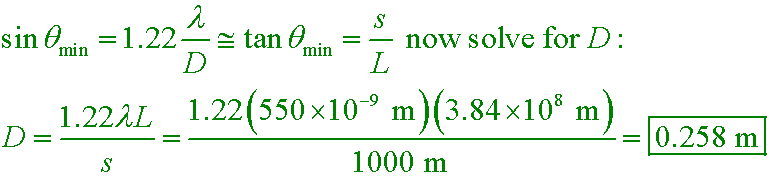
What minimum diameter telescope on Earth is required to resolve objects on the Moon's surface that
are 1.0 km apart? λ = 550 nm and L = 3.84×10⁸ m.
A. 2.06 m
B. 0.918 m
C. 0.774 m
D. 0.258 m
Answer
Walker5e 28.EYU.5 mod
If you view the world with infrared light, is your resolution greater than, less than, or equal to your resolution when viewing the world with visible light?
A. greater than
B. less than
C. equal to
Answer
Walker5e 28.85
The colossal squid (Mesonychoteuthis hamiltoni) has the largest eyes documented in the animal kingdom, at least 27 cm in diameter. The eyes are large in order to see in dim light, but they also have terrific resolution. If the squid's eyes are free of defects, find the maximum distance at which the squid could distinguish a pair of lights on a ship that are separated by 1.8 m. Assume 555-nm light, a pupil diameter of 11 cm, and an average index of refraction for the eye of 1.36.
A. 25 m
B. 400 m
C. 2.5 km
D. 400 km
Answer
C. blue, because of its shorter wavelength
The resolving ability of a microscope is limited by the diffraction of
light through its optical elements. Shorter wavelengths will diffract less and provide better resolution.
Electron microscopes have the best resolution because they use electrons that have much shorter "wavelengths"
than does visible light.
A. dark cloudy day
On a cloudy day your pupil diameter will increase in order to allow more light in. This will decrease the angular size of the diffraction pattern created by the pupil and increase the resolution. This
reasoning is true if the resolution of the eye were limited by diffraction effects. However, in practice there are
other aberrations of the eye that worsen when the pupil is wider, and we can generally see slightly better on a
bright sunny day.
D. 0.258 m
B. less than
The longer wavelength of infrared light means more diffraction, a larger angle θmin, and a decreased ability to distinguish two objects in the distance. In contrast, a smaller θmin would correspond to a greater resolution.
D. 400 km
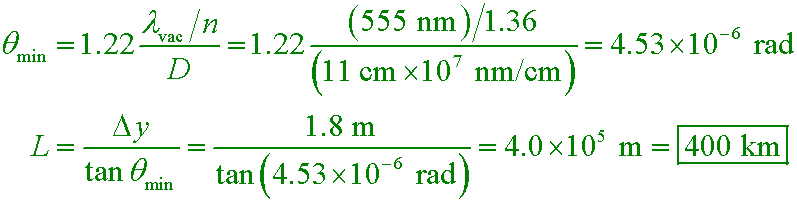
Notice that the wavelength of light inside the squid’s eye is reduced by the average index of refraction n = 1.36 of the eye (Equation 28-4). This effectively reduces the angular separation that can be resolved and increases the maximum distance. The curvature of the Earth would make it difficult for a squid to see a ship that is 400 km away! Although squid eyes are not diffraction limited and could not see this clearly, their large eyes do give them a remarkable visual acuity.